05 / 14
2026
The Church's presence in MIND area will be articulated on three levels – ordinary pastoral care, interreligious dialogue and comparison between humanistic and scientific knowledge...
> Ramagrama Stupa Lumbini by Stefano Boeri Architetti
> Palazzo Verde by Stefano Boeri Architetti
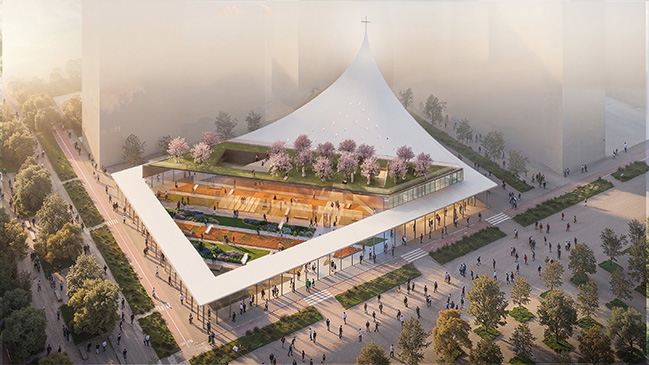
From the architect: The project presented by Stefano Boeri Architetti for the MIND area, commissioned by the Milan Curia, is conceived with the aim of creating a place capable of integrating the spiritual dimension and interreligious dialogue.
The new Monastery is developed over an area of 2,700 m², with 1,100 m² dedicated to open spaces, becoming an attractive hub not only for future residents of the MIND area and the nearby Cascina Merlata district, but for all the worshippers and citizens of the greater Milan metropolitan area.
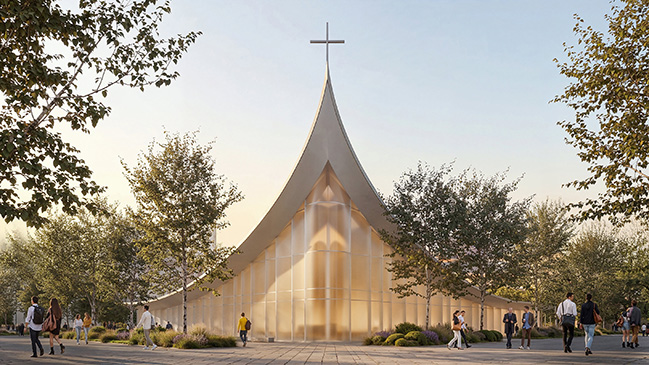
Inspired by the Christian monastic tradition, the project reinterprets the archetype of the cloister both as a spatial and symbolic device: an introverted yet permeable place, articulated around three fundamental dimensions —care, dialogue, and spiritual research.
The triangular-plan Cloister, located at the intersection of the Cardo and Decumanus axes of the MIND area, will be open to the flow of citizens and worshippers who, inspired by their religious communities, will care for the Garden of Religions and its plantings.
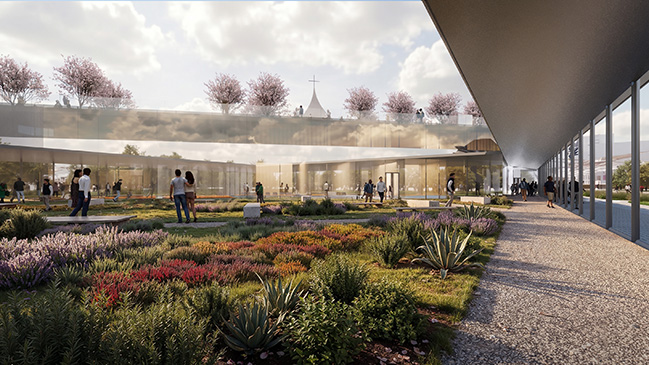
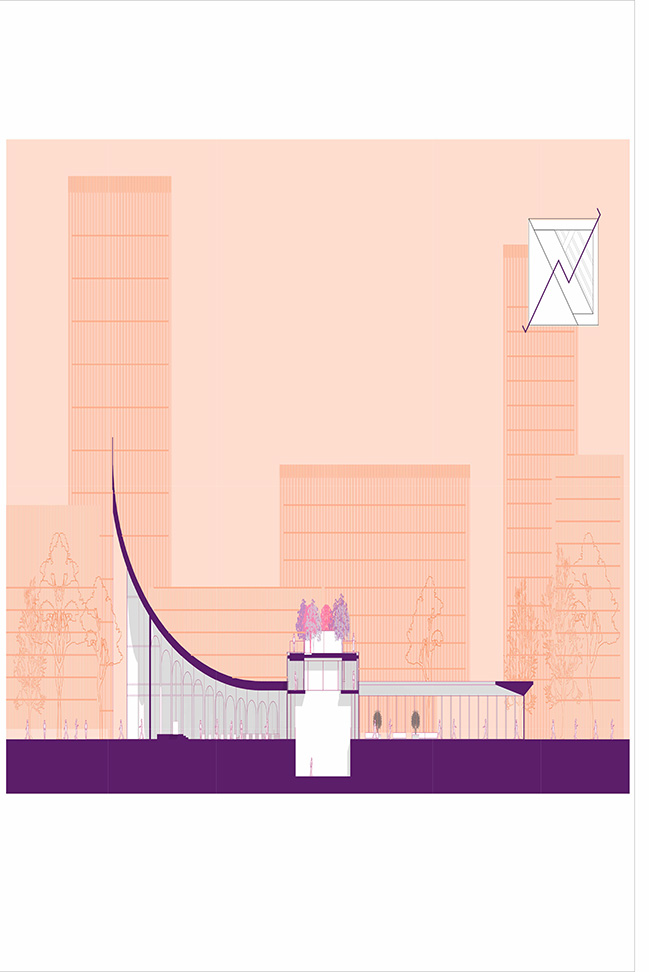
The Cloister is enclosed by an open colonnade along the sides of the Cardo and the Decumanus, which embraces the Garden and continues northwards to create a large ascending Sail within whose space the large central nave of the new Pastoral House opens, rising towards the north and houses the altar at its apex.
The new trigonal-plan church and its liturgical spaces are designed to accommodate up to 300-350 worshippers and is complemented by areas for community activities.
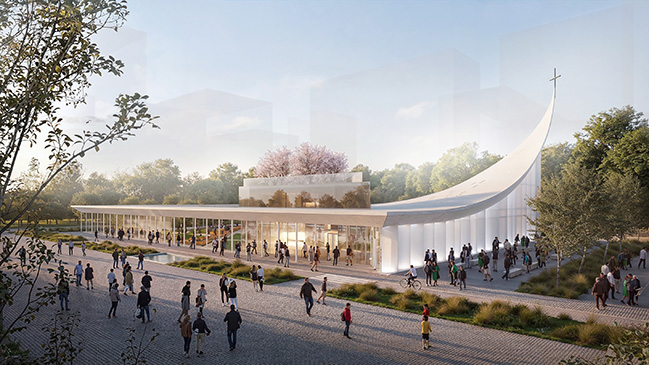
On an architectural level, the church develops as a material continuation of the cloister's roof, characterised by an ascending gesture that recalls the forms of the Milan Cathedral, as though the large Sail housing the new Pastoral House descended with its offshoots to embrace the Cloister of Religions and enclose it within its perimeter colonnades.
At the heart of this embrace lies the transparent, trapezoidal prism of the Library of Religions, dedicated to study and education, promoting interaction between the disciplines and religious traditions that characterize Milanese citizenship.
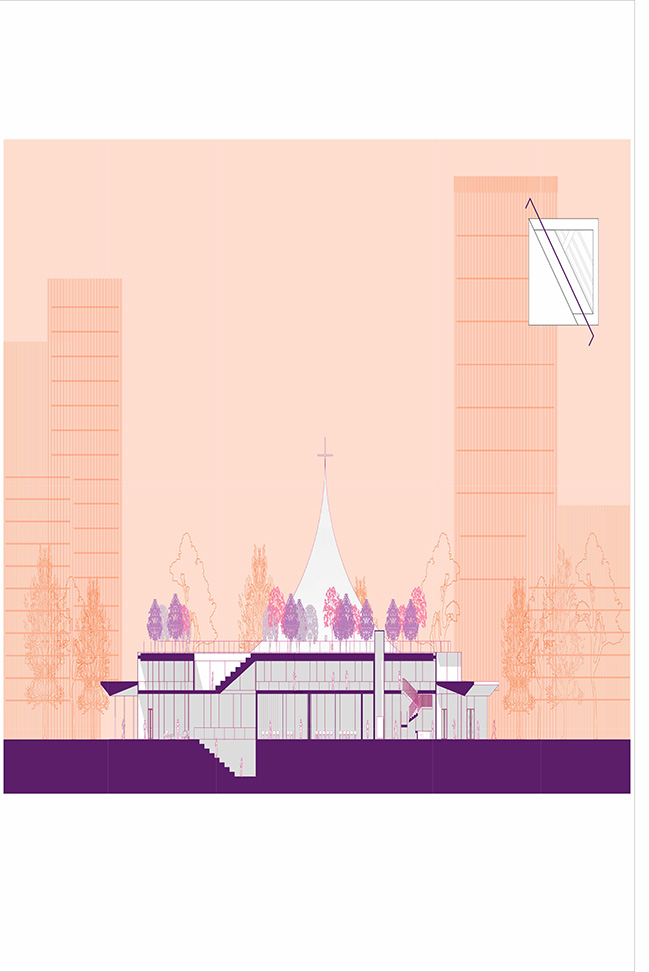
Inside the programme includes study rooms, an open-air amphitheater, multifunctional spaces and a section dedicated to pastoral care, with five attached residences.
On the roof, the Library hosts, among the cherry trees of a small grove, a selection of sculptures from the storage collections of the Veneranda Fabbrica del Duomo, almost as if, having descended from the spires, the sculptures wished to mingle with, and welcome, the visitors and worshippers ascending from the Library of Religions below.
A gesture of openness that aims to make an otherwise inaccessible historical heritage accessible to citizens.
Architect Stefano Boeri, founder of Stefano Boeri Architetti, stated: "We intended to shape the new Ambrosian Monastery with a unified and open architecture, whose spatiality would represent the embrace of the new church, the transparent prism of the Library of Religions, and the triangular cloister of the Garden of Faiths, located at the intersection of the Cardo and the Decumanus. A contemporary monastery, designed to meet the needs of a pluralist society and to promote social cohesion, interreligious dialogue, and the production of knowledge."
Architect: Stefano Boeri Architetti
Client: Archdiocesan Milan Curia
Founding Partner: Stefano Boeri
Partner in Charge: Marco Giorgio
Director: Hana Narvaez
Design Team: Giacomo Calistri, Daniele Barillari, Agostino Bucci, Mohamed Hassan Elgendy
Stefano Boeri Architetti presents the new Ambrosian Monastery
05 / 14 / 2026 The project presented by Stefano Boeri Architetti for the MIND area, is conceived with the aim of creating a place capable of integrating the spiritual dimension and interreligious dialogue
You might also like:
-

01/16/2026
ZHA-designed Bishoftu International Airport construction begins
-
12/04/2025
Foster + Partners-designed Zayed National Museum in Abu Dhabi completed
-
11/13/2025
Tiny House LUX by ODA Architects + Coral Architects
-
11/11/2025
The Suzhou Museum of Contemporary Art by BIG
-
10/27/2025
RENNERIA by NOA | A new neighborhood in the Dolomites
-
10/24/2025
Foster + Partners-designed new global headquarters for JPMorganChase completed

Recommended post: Swallowfield Barn by MOTIV Architects